
Geen categorie @en
Utilising garments for in the professional environment: sufficient stock versus efficient garments management

At organisations that use garments for uniforms, it is important that there are always clean garments available for all employees. Hygiene, uniformity, protection or a combination of the three are often the reason for utilising garments in the professional environment. But how many garments are sufficient to facilitate everyone? Out of precaution of having insufficient…
Read MoreAre your employees in line for a long time, waiting for clean garments?

Garments are personal protective equipment. In many countries, the law requires for employers to issue protective equipment to its personnel. For a small organisation, issuing garments is often a side issue, garments are purchased and distributed among the employees. Cleaning the garments often happens home or maybe in a small washing machine at the workplace. …
Read MoreLimit the loss and destruction of workwear with RFID chip technology

The use of workwear is becoming increasingly common in various sectors, such as the care, hospitality and food sectors, among others. Often, it is the employer who buys or rents the garments and then makes them available to her employees. The employee is expected not only to wear the garments while at work, but also…
Read MoreGuidelines for occupational garments regarding hygiene and infection prevention

Within various industries, the guidelines for occupational garments regarding hygiene and infection prevention are becoming increasingly stringent. Ensuring a clean and safe working environment is essential. An efficient approach is to distribute garments on a FIFO basis. And garment distribution machines provide a convenient solution. Importance of hygiene guidelines for occupational garments Hygiene guidelines for…
Read MoreManual vs. automated workwear management in healthcare

In many healthcare institutions, the issuing of workwear is still organised manually: through a service desk, a clothing cupboard with or without registration, and sometimes an Excel overview maintained by the facilities team. It works, but it also creates familiar bottlenecks. What changes when you switch to automated clothing issuance? And where do the trade-offs…
Read MoreDigital transformation in the laundry sector

The laundry sector has traditionally been an industry where physical processes take centre stage: washing, drying, ironing, folding, sorting, delivering. Machines and logistics set the pace. Yet the focus is shifting. More and more laundries are discovering that value lies not only in the washing process itself, but in the data and insight that emerge…
Read MoreDecentralised workwear dispensing: closer to the shop floor

In many industrial environments, workwear dispensing is organised centrally: a clothing store near the entrance, a counter at the staff entrance or a changing room some distance from the production hall. It works, but it also creates friction. Employees have to detour, queues build up at shift changes and availability depends on opening hours. An…
Read MoreHACCP compliance and workwear management: what is expected during audits?

In the food industry, workwear is more than just clothing. It is part of the food safety system. During HACCP audits, inspectors look beyond production processes and temperature control — they also assess how an organisation manages workwear, personal protective equipment (PPE) and the separation of clean and soiled items. Yet workwear management remains an…
Read MoreA better workplace at clothing dispensing: less strain on your facilities team
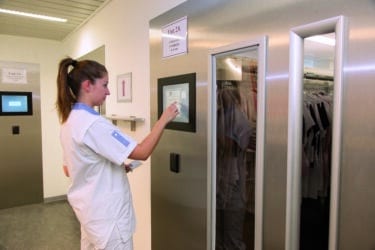
Have you ever stopped to consider that issuing work clothing puts not only a physical but also a mental burden on facilities staff? Sorting clothing by name, checking whether everyone actually has the right set of items, correcting mismatches and occasionally absorbing the stress of an employee who shows up for a shift without clean…
Read MoreFast and efficient loading of your dispensing system: how does it work?

We are increasingly being asked whether clothing should be delivered to the dispensing system pre-sorted. The reasoning behind this is understandable: as an additional control measure, or in case of a possible malfunction. Yet in practice we usually recommend the opposite: chaotic loading, combined with smart minimum and maximum stock settings per item. That also…
Read More